Jackson’s Catholic diocese propels Dixon Lindsay into both history and prominence
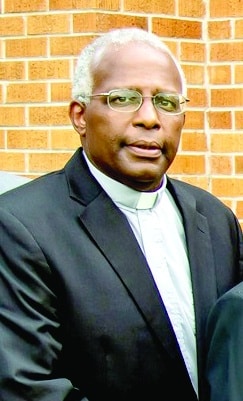
In an elaborate, Latin-laced ceremony at Jackson’s Cathedral of St. Peter the Apostle led by Bishop Joseph Kopacz, Dixon Wesley Lindsay and five other men – Mark Anthony Bowden, Dien L. Hoang, John Anh Pham, David Preston Rouch, and Anthony William Schmidt – were ordained as permanent deacons in the Catholic Church. Being the only Black man among them, Lindsay has thus followed in the historical footsteps of Deacon Sam Baker who had long served as the first Black permanent deacon in the Jackson diocese.
That honor bestowed upon Lindsay was the culmination of five years of formation/study and came after years of his academic brilliance being at last partially hidden/blocked. It was a fitting promotion for his life and dedication up to that point.
In 1983, on the campus of Jackson State University, we were fortunate to meet him as a young political science major. Since that time, we have remained in contact with him, enabling us to not only recognize but experience his talents and brilliance as an African American male who grew up in West Jackson, graduating from Jim Hill High School and Jackson State University (JSU).
In 1984, Lindsay earned a Bachelor of Arts degree in political science with highest honors. Of lesser notoriety, but with equal academic prowess, he served on the first JSU Black History Bowl team that went undefeated on the campus. Other members of the team included Alice Hardy, Mickey Jones, Viacin Jones, and Daniel Watkins. In later years, that bowl expanded, competing with other historically Black colleges and universities and was then dubbed the Honda Campus All-Star Challenge bowl.
After graduating from JSU, Lindsay was admitted to Mississippi College School of Law. There, he shone as a law student from 1985-88, completing the program and being commissioned as an ensign in the U.S. Navy. Due to the high degree of racial discrimination at that time, however, he and the cohort of Black law students at the time were notified that they had failed the bar examination. It is ironic that prior to the enrollment of Black law students, Ole Miss graduates did not even have to sit for the bar exam; they were automatically licensed.
After failing to prevail in a racial discriminatory lawsuit over the matter, Lindsay began working for the U.S. Postal Service in Jackson and managing his family’s property in the city. Due to his level of political consciousness, he became an insightful political commentator, serving as a part-time co-host of Senator Henry Kirksey’s radio program, “The Truth”. His questioning and criticism included criticizing the role of the church in the area of race and social justice. That line of questioning led him from one congregation to another until he landed at Cathedral of St. Peter the Apostle, which was the site of Saturday’s ordination.
It should perhaps be noted that at that point three threads were merged – his exceptional intellect in the field of political science and public policy, his devotion to the church and its role in the public arena, and his unusual political consciousness which had been inherited from his family, going back at least as far as his grandfather, John Wesley, who was a long-time treasurer of the Mississippi State Conference of the NAACP. (JSU’s Dixon Hall is named in his honor.)
Lindsay joined Cathedral of St. Peter the Apostle and began assisting Fred Cunningham, who was sexton at the time. Upon assuming that position himself, he faithfully carried out its duties. As a capable, up-and-coming member of the church, in 2018 he was given the Bishop John Chanche Award for outstanding service, along with fifteen other lay members from around the Jackson diocese. This was soon followed by his entering the rigorous study program to become a permanent deacon in the Catholic Church.
As an ordained deacon, Lindsay is now able to baptize people into the Catholic Church, witness marriages, perform funerals and burials outside of Mass, distribute communion, preach, teach the Catholic faith, visit the sick, counsel individuals and groups, and assist priests in their parish duties. Although deacons are assigned to individual parishes or institutions by the bishop, they are available and able to carry out their duties anywhere that the Catholic Church has established itself. The position is, thus, one of prominence.
Lindsay is now a Catholic deacon forever, that is, until his death or retirement. The Catholic Church has recognized and gained a brilliant and dedicated man. It is even more significant that he is a Black man, who is able to exemplify and advance the kind of Christian religion that began in Africa and that increasingly reflects the people from around the globe. He is making history even as he is a link in that history.
Author