As the Mississippi State Legislature begins, the Legislative Black Caucus and other underrepresented groups prepare to advance their proposals

At noon on January 2nd, the state legislature was convened for its 2024 session. New House of Representatives officers were chosen, but the opposing line-ups of legislators remained the same. With Jason White as the Speaker and Manly Barton as Speaker Pro Tempore, the Republican Party maintained its better than 2/3 majority in the House compared to the Democratic Party. The same remained true for the Senate. Delbert Hosemann, as Lieutenant Governor, will serve as the presiding officer, with Dean Kirby serving as the President Pro Tempore of the Senate. That body also maintained its 2/3 Republican majority.
We draw attention to the Republican Party having a 2/3 majority in both houses in order to stress how easy it usually has been for that party and the Republican governor to have their way in terms of passing laws, and contrarily, how difficult it has usually been for the Democrats, mostly representing Blacks and other working class people, to get their proposals enacted and to block the oppressive proposals presented by the Republicans.
For starters, Governor Tate Reeves has already vowed to try again to get the state income tax eliminated. During his re-election campaign, his reiterated his opposition to authorizing Medicaid Expansion. Beyond that, because Mississippi is so heavily Republican and is so steeply involved in the American Legislative Exchange Council, Republican legislators are likely to re-introduce “anti-woke” bills that infringe upon First Amendment rights and due process. Similarly, proposals that restrict voting rights, expand gun possession and carrying, undermine the funding of public education, oppose legal immigration, and oppress already marginalized citizens are already being placed in the hoopers for consideration this session.
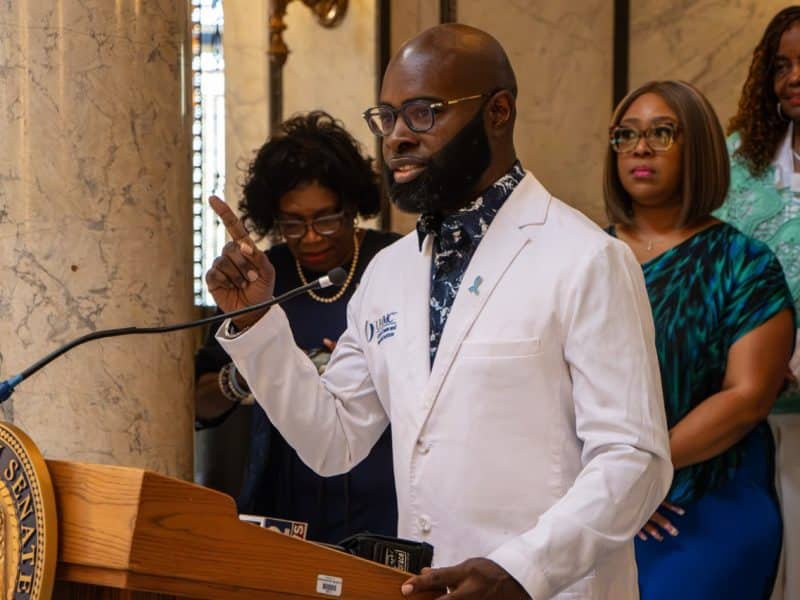
Meanwhile, the Legislative Black Caucus, chaired by Christopher Bell of Jackson – along with Robert Johnson of Adams County heading up the Democrats in the House and Derrick Simmons of Greenville heading up the group in the Senate – is busily completing its list of legislative priorities. Among them, they will work for some form of Medicaid Expansion and for a more equitable budget that will enable better funding for public education rather than the elimination of revenue such as the state income tax.
It remains thus to be seen how much cooperation there will be between Republicans and Democrats regardless of the inaugural speech of newly elected speaker Jason White. That is the case because it is crystal clear that the Legislative Black Caucus and Governor Reeves, at least, are on opposite ends of the political pole.
As the two sides gear up, long-term political advocates Rims and Judy Barber have announced that the Mississippi Human Rights Coalition will resume meetings each Monday at noon during the legislative session. The group will continue to monitor and organize around bills coming before the legislature as it has done since 1989. Nancy Loome of the Parents’ Campaign has made the same kind of announcement regarding bills relative to public education. Undoubtably, other groups of activists and organizers will be regularly at the capital trying to influence legislation.
As usual, the question is, “will enough groups show up early enough, long enough and be effective enough to make a real difference for those most in need?” It is one thing to engage in political battles, but more important is the outcome of the battles for those who are most in need.
Author