Women in the Mississippi Civil Rights Movement punctuate ‘History is Lunch’ sessions in March

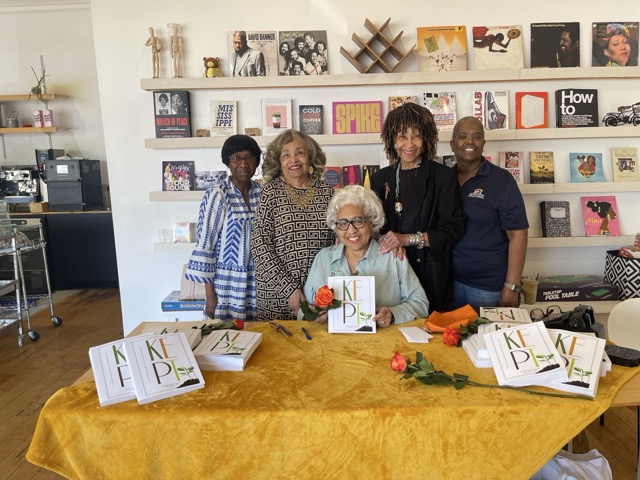
Writer and history professor Emilye Crosby led an insightful and informative discussion on women in the Mississippi Civil Rights Movement, which by coincidence closed Women’s History Month and the March schedule of the History is Lunch series. She used a quote from civil rights activist Ruby Doris Smith-Robinson, “Anything I was Big Enough to Do,” as the header for her talk and the title for her recent book on the subject.
Although she began her session by asking the audience to spend a moment respecting the recent passing of civil rights activist Dorie Ladner, the major purpose of her discussion was clearly to celebrate the memory and works of many women, such as Ladner, who had toiled in the Mississippi Civil Rights Movement in the 1960s. In addition to Dorie and Joyce Ladner, she described the essentially critical role of Ella Baker in organizing the Student Non-Violent Coordinating Committee (SNCC); of Diane Nash, who was a Fisk University student and a major organizer in the Nashville Movement; the Freedom Rides in Mississippi campaign; of Ruby Doris Smith-Robinson, who went on the become executive director of the Student Non-Violent Coordinating Committee; and several other well-known women in that era. As she discussed the women, she was eager to point out that the women she was spotlighting were those who had made a name for themselves, more so than those, such as Coretta Scott King, who although a leader herself was more associated with Dr. Martin Luther King Jr., or Rosa Parks, who was more associated with the National Association for the Advancement of Colored People (NAACP) and its legal initiatives strategy.
In addition to Baker, Nash, and Smith-Robinson, Dorie and Joyce Ladner were examples of direct action, community organizers. They had been mentored by martyrs of the movement – Medgar Evers, Vernon Dahmer and Clyde Kinnard – who helped develop them into strong, independent activists and organizers. These sisters had come out of high school as civil rights activists and continued through and after college. Fannie Lou Hamer was another woman who had risen to national notoriety as an activist and organizer with SNCC. She was unlettered, but extremely effective as a speaker and organizer, perfect model of the kind of women who filled the ranks of SNCC. There were still others, including Unita Blackwell, who through the strength of their character, their intelligence and their courage, made names for themselves, while improving conditions in their communities.
A major point in Crosby’s talk was that SNCC respected, utilized, and elevated women more readily than the NAACP or the Southern Christian Leadership Conference (SCLC). Most other organizations were more male-dominated in terms of their leadership, even though they often had many more women members and supporters. Men were most often the leaders and spokespersons, while women did the secretarial and “domestic” work.
In addition to its stance on women, SNCC was also more grassroots in its membership and more likely to have leadership by committee rather than a single, charismatic leader. Thus, the composition and structure of SNCC led to scores of women leaders, such as Unita Blackwell, Leesco Guster, Colia Liddell, Victoria Gray, Ann Moody, Euvester Simpson, Mattie Bivins, and Carolyn Daniels.
Perhaps because Mississippi, in the mid-1960s became the major focal point of the civil rights movement, attracting SNCC, there were more Black women leaders in Mississippi than any other state. Therefore, it should not have been a surprise that Fannie Lou Hamer was a spokesperson at the 1968 Democratic National Convention. Crosby was certainly not sparing in her praise of SNCC.
In the course of her discussion, it was pointed out that Black women, especially local Black women, were often out front as organizers in the towns of Mississippi because they knew the communities and because Black men would undertake the organizing on the plantations and because they would attract less attention than white women, given the paranoia of Southerners who were always on the look-out for and set against the possibility of inter-racial sexual activities. That condition also led several white women at the 1964 Waveland Summer Retreat to complain about the less prominent role they felt that they were asked to play.
It was an important admission in the discussion to state that after the events ended and the history was written, many local leaders and participants were not given their due recognition. June Johnson of Greenwood, L.C. Dorsey of Shelby, Susie Ruffin of Laurel, and Brenda Travis of McComb are among such women. There were hundreds of others who may remain nameless. As has often been the case, the humble or soft-spoken, the poverty-plagued and low-incomed, and the unlettered among them often took back seat to others in terms of publicity and recognition.
Despite that reality, however, reviewing those “golden years” of direct action for civil rights and the ascendancy of Ella Baker’s Student Non-Violent Coordinating Committee was a very worthwhile experience for not just veterans and scholars of the movement. It was the kind of presentation that is most essential for the younger generation and for those who had little or no knowledge of such activity in America’s history. For that reason, we continue to appreciate “History is Lunch” each Wednesday at noon and the discussions such as the one by Professor Emilye Crosby.
Author