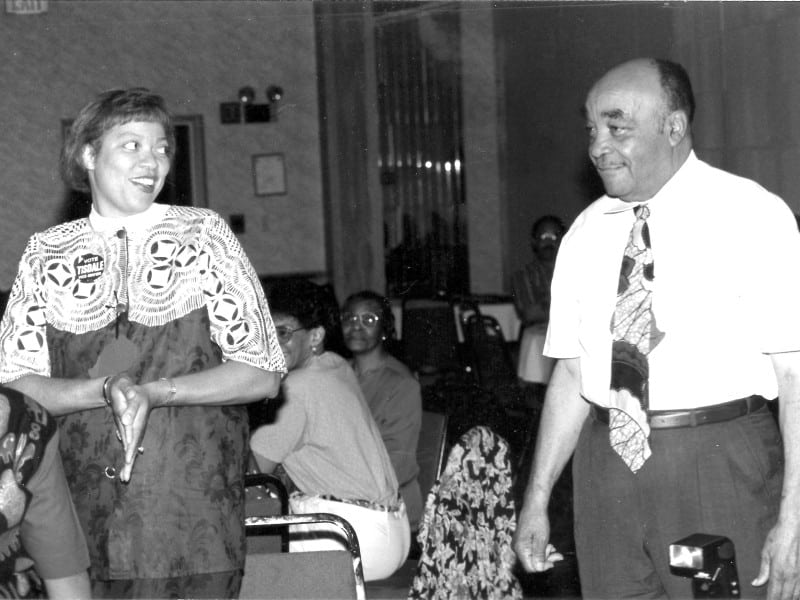
My reflections on Charles Tisdale, the notable publisher and freedom-fighter who was born 100 years ago this week
By Ivory Phillips
JA Contributing Editor
It is a tremendous honor to pen a few words on this the occasion of the 100th birthday of Charles Tisdale, whom we first met 48 years ago. There are but a few individuals who knew him and worked with him for such a length of time, although they may have known of him through his writings and through his activism.
Back in 1978, shortly after Tisdale bought the Jackson Advocate from Mrs. Frances Greene, widow of founder Percy Greene, the writer was approached about writing a campaign article on behalf of Henry Kirksey who was running for the Mississippi State Senate. Being aware of the reputation of the newspaper in the Black community, Kirksey declined the offer until he was informed the paper not only had a new owner, but a totally different editorial stance.
To now say Tisdale had taken the paper in a new direction would be putting it mildly. The revised Jackson Advocate had become perhaps the most progressive Black paper south of the Mason-Dixon Line and east of the Mississippi River.
Following this revelation, the writer approached Tisdale about writing for the paper on a regular basis. To his surprise, Tisdale not only welcomed him as an editorial writer, but gave him free reign to write on whatever topics he chose. That kind of attitude demonstrated the kind of paper Tisdale desired the Jackson Advocate to be, going forward. It demonstrated Tisdale was willing to publish the truth no matter how critics may have felt.
On one occasion, as the writer feared Jackson State University would be placed under the administration of a tyrannical individual who was highly disdained by the faculty, he wrote the most scathing article of his career. The article was so critical and detailed that the writer used a pseudonym. Because Tisdale agreed and wanted to get that truth out, he published it under that pseudonym, but on the same prominent editorial page as usual.
On a similar occasion, Tisdale blasted the owner of a local Black-owned radio station so soundly and consistently until he was removed from the air, requiring a lawsuit to continue his weekly broadcast.
Tisdale’s determination to become the authentic voice of Black Mississippi was not a quick and easy task. For example, during one stretch in the revised paper’s early career, he hired and fired five different editors within a six-month period, in an effort to find the right individual to carry the message. Often, he simply assumed the editorial role himself. There were times when individuals, upon whom he depended or relied, either shrank from a position or took a more compromising position. Tisdale would say to others, “she/he is afraid of white folks,” and then move on to someone else the next time around.
Being a true freedom-fighter, Tisdale did not pick and choose who would be attacked or spared in his assessment. He famously created his version of “The Brown Society”, listing people he believed had taken stands contrary to what was best for Black society. Black political, religious, education, and business leaders dreaded being listed in “The Brown Society”.
Beyond listing leaders in “The Brown Society”, Tisdale was not reluctant to target or criticize others for actions they had taken. For example, the writer once threw his hat in the ring as an independent for mayor of Jackson in case there was only a Democrat and a white Republican nominee left standing after the primaries. Believing such a tactic would make it difficult for a Black Democrat to make it through the Democratic Primary, Tisdale blasted this writer as he had done others in the past, calling this writer a “pseudo-intellectual” who needed to drop out of the race. After the political race was over, our wonderful working relationship resumed.
Whether he was operating as a newspaperman, a radio commentator, or the leader of an activist organization, Tisdale’s was a powerful voice for freedom. He was such a force that on several occasions his newspaper office was attacked and once his home on Eastview Street. On innumerable other occasions, advertisers upon whose contracts he depended refused to do or continue doing business with him, hoping to starve the newspaper to death. As these periods occurred, however, many writers kept the paper afloat by donating their labor to the paper. They did so because they appreciated Tisdale’s efforts in standing up for the Black community.
Tisdale was well-known and highly-respected in the Black newspaper world. He knew and/or had developed relationships with people in New York, Los Angeles, Memphis, and throughout the state of Mississippi. This helped give him a national voice. His acquaintances and connections continue to benefit the Jackson Advocate today.
As his health began to decline, Tisdale surrendered leadership of the newspaper to his wife, Alice Thomas Tisdale, with one public request, that the Jackson Advocate not become, “a society rag.” She and his beloved daughter, DeAnna Tisdale Johnson, have kept the newspaper alive since his death as a viable Black newspaper that continues to serve as “the Voice of Black Mississippians.”
Always proud of the role Tisdale played in his career, the writer was honored to serve as a pall bearer at his funeral and burial. It was significant to Tisdale himself to have his burial at sunrise, which did in fact take place at dawn on the rainy morning of July 15th. That, too, is a signal memory the writer has of Charles W. Tisdale, “a man among men.”