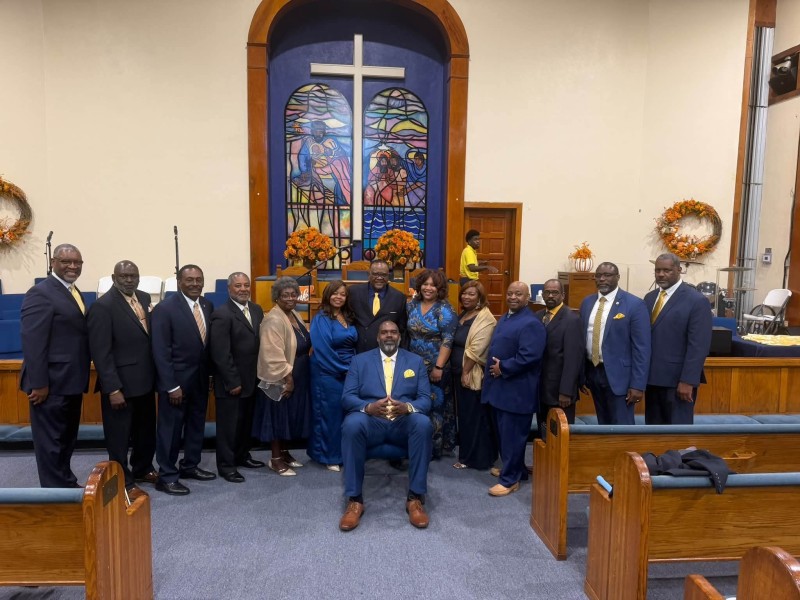
Provine graduate completes 40 years of U.S. Navy and federal government service
By Alvin Plexico
JA Guest Writer
Millington, Tenn. – Before Julius Evans started what would eventually become two careers and four decades of service to the U.S. Navy, first as active duty, then as a civilian, he was a student at Provine High School in Jackson, Mississippi. To say he had a challenging time there would be an understatement.
“I had a lot of disciplinary problems when I was in high school,” Evans said. “I was expelled on my first day as a senior. The head principal told me to leave and never return. I returned the next day. While I was readmitted, I went on to be suspended four more times. I vowed to never return to school again.”
Evans liked to party in high school, which was not conducive to academic success, but it would eventually lead him down a 40-year path of service in the U.S. Navy – 20 years as an active-duty sailor and 20 years as a government civilian.
“After we relocated to Jackson, from Westhampton Beach, Long Island, NY, my sister was friends with a Navy recruiter,” Evans said. “I was in the 11th grade. The recruiter asked what I liked to do, and I said that I liked to party. That weekend, he took me to a party, and I remembered thinking to myself, ‘If this is how the Navy parties, I’m down!’ So, I decided to join the Navy and was assigned to the Navy’s Delayed Entry Program for 11 months before going to boot camp.”
But the disciplinary problems followed. Eight days before he was to go to boot camp, Evans’ trip was diverted. He got into trouble with the law and ended up going to Memphis to receive a commanding officer’s waiver. While he was allowed to join the Navy, he continued to visit commanding officers through four instances of non-judicial punishment.
But his personal resilience and tenacity proved valuable and guided him through years of turbulent behavioral issues that he ultimately corrected and got on the right course.
Evans came a long way from his high school days, eventually going on to earn two master’s degrees, a Bachelor of Science degree, and an associate degree. The associate degree is in liberal studies, the bachelor’s degree is in mass communication and journalism, one of the master’s degrees is in strategic communication and leadership, and the other in national security and strategic studies, with emphasis on homeland security and homeland defense.
“I grew up in the Navy and then went on to mentor a number of other young men. I coached them to discover the innate value they possess,” Evans said. “I struggled with disciplinary issues early in my Navy career, so I know that if I can turn my life around, others can as well. If some of my closest high school associates could see me now, they would say with disbelief, ‘Oh no. I know that’s not Julius Evans. That can’t be him.’”
Evans served as an A-6E Intruder jet engine mechanic with the VA-145 Swordsmen in Whidbey Island, WA, as an enlisted sailor before transitioning to journalism at the Defense Information School, Fort Benjamin Harrison, Indianapolis, Indiana. It may not have seemed like a natural transition, but there was a natural connection for Evans.
“I didn’t know that writing was a thing,” Evans said. “I’m not even sure how I got started, but I enjoyed working on the aircraft so much that I wanted to share the experience with other people. I started writing about the type of work I did, the peacetime missions, and the functions of the aircraft. When I received clearance, I wrote about the payloads.”
Evans’ writing about aircraft would lead to a change in enlisted jobs.
“When it was time to reenlist, the career counselor told me the Navy was at a crossroads,” Evans said. “It had too many mechanics and only a certain few were being allowed to remain in the career field. Evans was invited to remain a mechanic, but the counselor advised that this would be a great time to change. ‘You’re an outstanding writer,” he said. ‘Have you ever considered becoming a Navy journalist?’”
The experience as an enlisted Navy journalist would eventually lead to Evans being selected as the Public Affairs Officer for the U.S. Army’s Joint Program Executive Office for Chemical and Biological Defense. He would later become the U.S. Army director for strategic communication, Program Executive Office, Ground Combat Systems, which ultimately ended with his post-retirement career as a Navy civilian public affairs officer.
Evans served a Navy that operates far forward, around the world, and around the clock, promoting the nation’s prosperity and security.
With 90% of global commerce traveling by sea and access to the internet relying on the security of undersea fiber-optic cables, Navy officials continue to emphasize that the prosperity of the United States is directly linked to recruiting and retaining talented people from across the rich fabric of America.
“The Navy gives you a perspective on time,” Evans said. “When you go out to sea, you’re watching the clock and calendar awaiting your return home. You go to shore duty, knowing that at some point, you must go back to sea duty. Your family is home waiting as well. There’s the 20-year clock. That’s when you can leave the military with a retirement. Then, once you are gone, you look back at the time you had and always end up saying, ‘Time goes by quickly.’ The Navy gave me a perspective on the passage of time and showed me how wise people can share their knowledge with younger people.”
Evans is grateful to others for helping make a Navy career possible.
“Most of my family are still in Mississippi,” Evans said. “My sister, Whitney Alexander, lives in Jackson, and my older sister, Lessie Hayes, lives in Terry. They have been on this journey with me, and I want them to both know that the journey would not have been the same without them.”