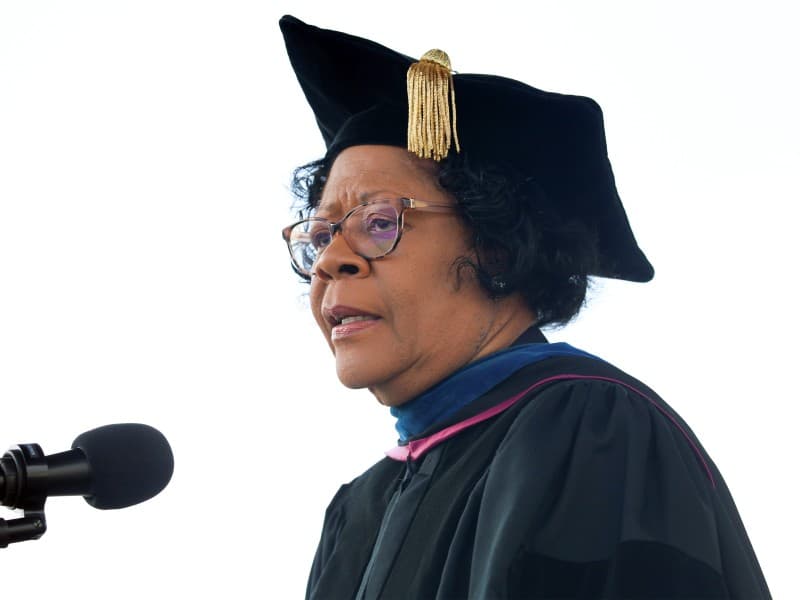
Jasmine Marchbanks-Owens: Continuing Dr. King’s work as a voice for justice in Mississippi
When Jasmine Marchbanks-Owens reflects on her journey into the legal field, her story begins not in a courtroom but in the lived experiences of her early life in Rancho Cucamonga, California. Witnessing the stark disparities that exist between neighborhoods and communities sparked her passion for advocacy at a young age. “I definitely saw disparities, inequalities based on people’s zip code,” she recalls. “That started getting me interested in being an activist and using my voice.”
Her path to law was solidified through personal adversity. During graduate school, Owens became the victim of a hate crime, receiving threats that lasted for months. The experience left her feeling silenced, an unsettling encounter with the limits of personal protection and systemic justice. “It really scared me,” she admitted. “That is what led me going into law school, to make sure somebody else would not have to experience what I experienced and to understand my rights.” This moment spawned her commitment to advocacy and shaped the lens through which she would approach the law. As a tool to empower historically marginalized communities.
Owens chose Howard University for law school, drawn by the legacy of the HBCU in cultivating legal minds committed to justice. “Howard really transformed the way that I look at law. They were very invested in ensuring that we implemented and included the Black experience, Afro Feminist Thought and Intersectionality and practical applications of the law.” For Owens, Howard was more than an academic institution, it was a space that nurtured her voice and reinforced her mission to use law in service of the community.
Following graduation, Owens began her legal career as a law clerk for Court of Appeals Judge Latrice Westbrooks. In the appellate environment, she discovered the nuances of justice beyond the trial court. “Our whole job is to ensure that justice is being served at the trial court level,” she mentioned. “Being in the appellate field feels like movement work, ensuring that people have access to their rights under the Constitution.” Her experience in Mississippi’s appellate system has provided her a unique perspective on how law intersects with race, class and poverty, allowing her to see firsthand the systemic challenges faced by communities across the state.
Despite the widespread trend of young attorneys leaving Mississippi to pursue opportunities elsewhere, she is grounded in the skills and lessons she is learning in Mississippi and is committed to carrying them forward to deepen her practice of movement lawyering in service of grassroots struggles, both locally and abroad. She cites the resilience and interconnectedness of Mississippi communities, particularly in Jackson and the Delta, as central to her decision. “Jackson is a city where the community works together for the community, by the community, to meet the gaps that the state itself is not meeting,” she observes. Owens sees her presence in Mississippi as both a personal mission and a social responsibility. To learn, contribute and implement models of justice that could inspire change locally and nationally.
Mentorship has played a pivotal role in Owens’ journey. From connecting with current Howard students before law school to learning from seasoned attorneys and judges, her path has been shaped by guidance, encouragement and access to networks that open doors. Owens, in turn, pays it forward by mentoring law students interested in movement lawyering. She describes this as “creating a lineage of creativity and justice oriented attorneys” and ensuring that the next generation has the tools to effect meaningful change.
As a young Black woman entering the legal field, Owens is acutely aware of the gaps in representation and perspective within the justice system. She notes the stark underrepresentation of Black attorneys and women, particularly in leadership roles. “Only 5% of attorneys are Black and less than 2% are women,” she says. Her generation, with access to global information and platforms, is uniquely positioned to rethink what justice and equity should look like. Not just locally but internationally.
Looking to the arc of her career, Owens envisions a legacy that extends beyond her immediate legal work. “One of the reasons I came to Mississippi was to become an excellent attorney, not just a great attorney,” she explains, drawing inspiration from her family history. Her great grandmother was born into slavery and her great grandfather worked as a sharecropper. Owens is determined to create opportunities of which past generations dream. She hopes to build a world where historically marginalized people can thrive with full access to their constitutional rights, a vision she calls “working myself out of a job.”
Owens’ journey has been informed not only by personal experiences and institutional guidance but also by influential figures who introduced her to the possibilities within Mississippi’s activist legal community. She credits leaders like fellow Howard Law alum Rukia Lumumba, whose passion for Jackson’s community centered approach to justice helped Owens see the potential for transformative legal work in the state.
Today, Jasmine Owens stands at the intersection of advocacy, mentorship and justice, driven by a mission to further the lessons taught by Dr. Martin Luther King Jr. She is using the law as a tool for empowerment. Her career in Mississippi is more than a professional pursuit. It is a commitment to the teachings of Dr. King, a pledge to mentor the next generation, and a dedication to creating systemic change that reaches far beyond the courtroom.