In the History Corner… The Bible Belt, an enduring historical misnomer
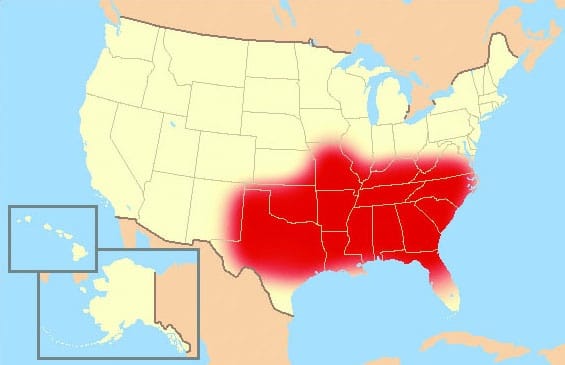
Ninety-seven years ago, journalist and social commentator H.L. Mencken referred to the region inclusive of Texas, Oklahoma, Missouri, Arkansas, Louisiana, Mississippi, Alabama, Tennessee, Kentucky, West Virginia, Virginia, Maryland, Delaware, North Carolina, South Carolina, Georgia, and the Florida panhandle as the Bible Belt. He dubbed it such because the majority of the inhabitants professed to believe in protestant Christian teachings and to have a preference for public policy based upon Biblical principles.
It is true that from 1924 to this day, compared to other regions of the country, this Bible Belt has had its residents express their faith more openly and attend church more frequently. If that was the full story, Mencken’s tag would be quite accurate and perhaps even warranted. Likewise, if one only looked at the region in those latter years, there may not be as serious a question raised as there is.
Here it is clear that we are talking roughly about the southeastern section of the United States of America. As a region, please note that it has been somewhat distinct since roughly 100 years before Mencken’s writing. Its adoption and legal embrace of slavery promoted a political philosophy. And its subsequent economic, social, and political actions set it apart. It may be coincidental that many of its white inhabitants embraced protestant Christian church membership. We say that it may be coincidental because often individuals create or search for “justifications” to support what they have done, are doing, or plan to do.
Writing, therefore, in the 1820s, one could very well have referred to the southeastern United States as “the Slavery Belt.” Many white inhabitants accepted Black slavery as an institution. Furthermore, many of them interpreted Biblical scriptures as justifications for slavery. As one proceeds from slavery, it is the same region, the southeast, that most visibly and adamantly promoted Jim Crow laws and practices. The violent struggles during Reconstruction to suppress the Black vote and otherwise re-enslave Black people were often led by the Ku Klux Klan, which touted itself as a Christian organization. Furthermore, since then more than 75% of the country’s racial lynchings have taken place in this region, as white supremacists sought to keep Black people “in their place.”
Having re-inserted themselves in power all over the southeast, even in counties and communities where they were in the minority, white supremacists closed ranks to oppose the Brown vs. Board of Education decision, the Civil Rights Act, the Voting Rights Act, the Open Housing Act, and other such efforts to provide equal protection for all citizens. The region again manifest itself very distinctly as a “Racial Oppression Belt.”
Parallel with the racial oppression of Black people has been the clear assertion of patriarchy, the holding of women to a lower status than men. Whether it has been the right to vote, the right to own property, equal pay for equal work, or the right to an abortion, the so-called Bible Belt has trailed the rest of the country. Often it has been and still is strongly opposed to the expansion of democracy beyond white male hegemony. Is it “the white patriarchy belt?”
Similar to the biases based upon race and gender has been the region’s bias against the working class. It is no wonder that poverty is more prevalent and opposition to wage increases lags behind the rest of the country. Big corporations race to establish plants in the southeast because the leaders here will not push for fair wages. They have historically sought to keep the working-class poor enough to accept whatever jobs were available at whatever wage was being offered.
Additionally, going back to the days of slavery, states in the southeast have been the least willing to support public education. They have felt no need to assist the working class in becoming effective competitors with the elite nor to assist them in bringing about change. A companion piece to that attitude is the penchant of many in the region to turn their back on the findings of science. That was the case regarding the theories of human revolution; it is the case regarding COVID-19 and climate change. So, what belt is it in these cases?
We point to all of these negatives, not so much to condemn the region, but to indicate that the moniker of the southeast as “the Bible Belt” is a misnomer. Much of what is socially, economically, and politically characteristic of the region is diametrically opposed to what is taught in the Bible, even if everybody believed in the Bible as a sacred book. The southeast’s hard-core stands on race, sex, class, and much more is clearly in opposition to the idea of love and concern for all humankind, which one would expect from sincere Christians.
If its leaders insist that somehow the southeast is the true Bible Belt, it is obvious that they miss the point that historically, they’ve made it “the hypocrisy belt.”
Author