Happy Birthday Murlene Terry Taylor
“Even if people ill-treat you, still be kind.”
— Murlene Terry Taylor
By Alice Thomas-Tisdale
JA Publisher Emerita
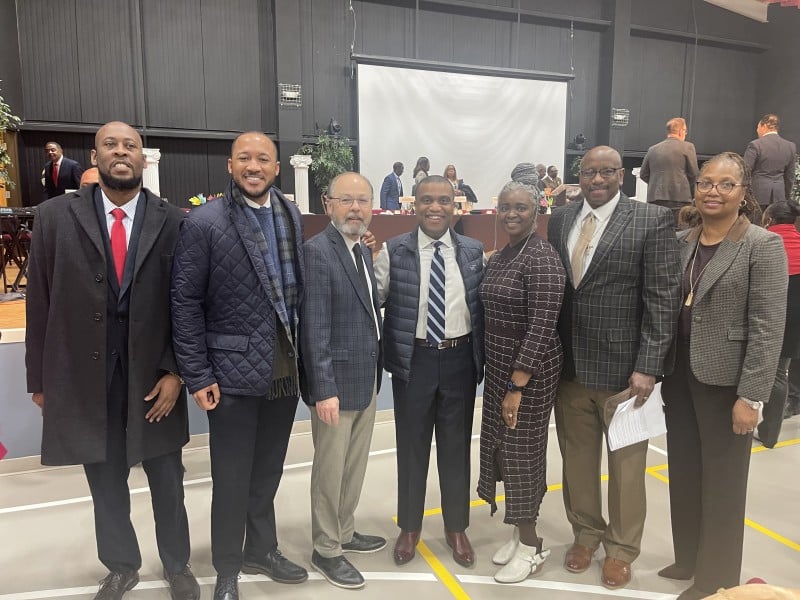
Family and friends gathered Sat., January 24, 2026, at Central UMC Family Life Center located in the Historic Farish Street District to celebrate the 90th birthday of community treasure Murlene Terry Taylor. Her brother, Herbert Terry, served as Master of Ceremonies.
Guests were welcomed by the celebrant’s niece, Rev. Michele Wheatley, after she and the honoree’s sister, Florence Terry Pullen, escorted her into the elegantly decorated center in her sorority’s (Alpha Kappa Alpha) signature colors of pink and green. And since she was tinkled pink with all the fanfare just for her, rocking a vintage green dress was quite the order of the day!
Thunderous applause was seamlessly replaced with music by Kerry Thomas and tributes by family members, Dr. Juanita Sims Doty, Dr. Brenda K. Thompson, Dr. Mitchell Shears, Michael Morris, and Bobbie Jean Turner. Central District Public Service Commissioner DeKeither Stamps, State Senator Sollie Norwood, and First Lady Lydia Cole Horhn also expressed appreciation for her beyond belief volunteerism.
In between all the presentations, a delightful meal was enjoyed.
The program concluded with words of sincere thanks from the birthday girl, a heartfelt toast to her, and dancing tunes provided by Darrin Griffin (DJ Gripp).
The following passage was previously written by Murlene Terry Taylor describing her upbringing and commitment to the Beloved Community. In appreciation of her wonderful life of service to family and community, we dedicate this MLK commemorative edition to our shining star!
I grew up in Learned, Mississippi. My parents were farmers, and I picked cotton. I have long fingers that were good for pulling the cotton out of the bulb. It was traumatic but that was our livelihood. One-fourth of everything we raised went to the landlord. If we had four tomatoes, one went to her. She was a nice lady and respected our family. We walked over two miles to school. Our books were used textbooks that the white folks had. They were damaged and pages were torn out. Things weren’t separate but equal. It was a bad feeling, but that is the way it was. I was fortunate that mother could read and could teach me, too.
I used to do seamstress work and made baskets. I was a self-taught beautician because we had to develop a career for ourselves. People walked for miles to my parents’ home for me to press and curl their hair. Two weeks later they would walk back to do it again.
Years later, my father was blind and my mother wanted to buy land. Our landlord told her that if she sold her land then she would have to leave Mississippi because white folks couldn’t sell land to Black folks. Our landlord’s sister-in-law heard about this. She had some land and sold it to me. I built my parents first home, a beautiful colonial-front house. They are gone, but I will never sell it. That house meant so much to them and added years to their loves.
You have to be yourself. No one can be you but you. You have to be true to yourself, honest and fair. No one can change you but you. When I was a baby I had polio, but nothing was wrong with my brains or my hands. I went to Alcorn State University and was the first person in my family to get a college education. I paved the way for my younger siblings and they all got degrees. The white universities wouldn’t let us in. I was immediately hired to work in administration at Jackson State University and worked there for thirty years with honor. I never had another job, but I have been giving my time away ever since then.
I also worked with Medgar Evers doing some of his typing and office work. Medgar was in a meeting at the Masonic Temple the night he was shot. He went home as usual. The next morning he was gone. I am working now with Mrs. Evers on a special program called the A-TEAAM, a leadership development program that is mentoring young males of color. Twenty-one organizations are involved as mentors and we are creating a village for these young men. They are startled when they begin, but they are happy when they make it through. Many come from single parents homes and learn that other people care about them.
I try to be kind to everyone. Even if people ill-treat you, still be kind. Some of our leaders want to push people back. We aren’t going to let that happen. We have come too far to go back. We had to struggle for what we have today, but I have hope that things will keep getting better. They have to.