Hansberry brothers lauded at History is Lunch forum
By Ivory Phillips
JA Contributing Editor
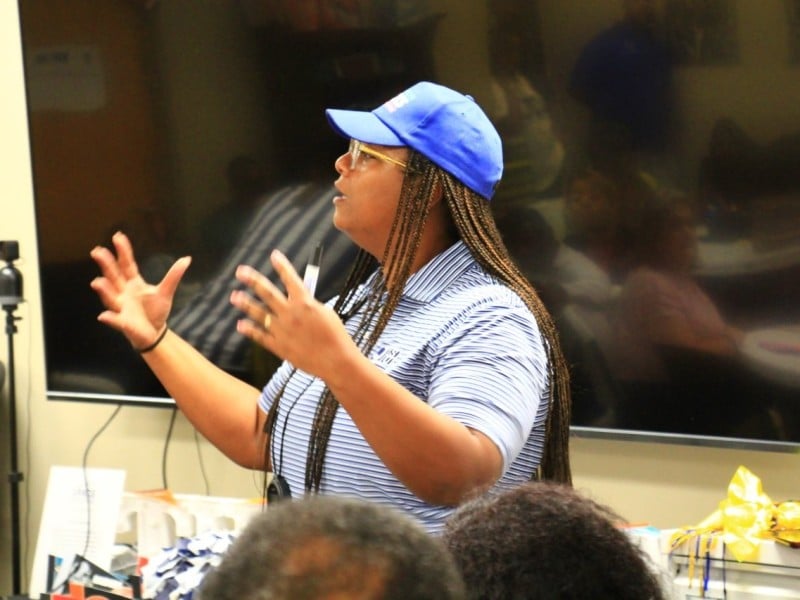
On Wed., April 8, many attendees of the History is Lunch Series were in awe as Dr. J. Janice Coleman, an English Professor at Alcorn State University, who is from Mound Bayou, presented a paper and responded to questions regarding William Leo Hansberry and Carl Augustus Hansberry, two brothers who are of great historical importance, both of whom hailed from Gloster and attended Alcorn A&M College. The audience reaction was such because the brothers, despite their contributions, have far less notoriety than Carl’s daughter and William’s niece, Lorraine Hansberry.
Dr. Coleman, in what was apparently a labor of love, narrated the backgrounds of the brothers, including the fact their father, Elden Hayes Hansberry, attended and taught at Alcorn. Before embarking on their separate careers, each spent time trying to earn a living in the local area, which tells one something about life at the beginning of the Great Migration.
In lauding the two, Dr. Coleman began with William Leo Hansberry; how and why he left first Alcorn and then Atlanta University in search of more research resources on African history and culture; continued his studies at Harvard University, but was unable to secure a doctoral degree there because there was no faculty sufficiently knowledgeable to guide his research in African studies; and how ended-up teaching at Howard University.
She lauds William Leo for beginning the first African Studies Center at Howard University and perhaps in the world. While he was not publishing books as some would like to have seen, his articles did appear in EBONY magazine and in THE CHICAGO DEFENDER newspaper. He was lauded because his work was so pioneering. He expressed the idea of an Afrocentric development of the world, being a first and far ahead of his time. His extensive research on and travels to Africa were supported by generous grants from several sources. Many African students attended his classes, including Kwame Nkrumah and Nnamdi Azikiwe.
At the same time, she points to the reasons why he was not given his due as a scholar. It appeared to her to have been professional jealousy; claiming he had not been publishing his work and that much of it was not documented. After years of not been appropriately rewarded, including the loss of grant funds, Howard University attempted to make amends by granting him tenure and a promotion, and naming a hall and a lecture series in his honor, posthumously.
In lauding Carl Augustus Hansberry, Dr. Coleman noted that unlike his brother, he remained at Alcorn until he graduated, but did get into trouble for being a student protest leader. After graduating, he immediately began making moves to become wealthy. Among those moves were becoming a bank accountant, establishing his own bank, and becoming a real estate entrepreneur. Consequently, within a few years, he was wealthy and well-known in Chicago’s rapidly growing Black population.
As a real estate entrepreneur, Carl devised the idea of creating what came to be called “kitchenette apartments.” Such facilities met the needs of many residents who could not afford more traditional housing facilities. At the same time the move helped Hansberry rapidly increase his wealth.
Additionally, Carl Hansberry made judicial history by being the plaintiff in the case of Hansberry vs. Lee. In that case, racially restrictive covenants were being used to preserve segregated housing. Hansberry’s suit, which was supported by the NAACP, showed how the covenants violated the Fourteenth Amendment. Together with the 1968 Fair Housing Act, the favorable Supreme Court decision desegregated housing around the country. She bemoaned the fact that despite the importance of the suit, many people have no idea who he was.
Thirdly, Dr. Coleman asserted that Carl Hansberry should also be recognized for playing a major role in organizing the famed Woodlawn Neighborhood Association in Chicago and for helping his wife, Nannie, raise their four children, including poet Lorraine Hansberry.
As she closed her talk, Dr. Coleman referenced two other celebrities, Chester Hines and Alex Haley, who spent time at Alcorn as a part of their development. That inclusion looms important as efforts to downgrade the role of HBCUs intensify.
Although the Hansberry brothers, and those who have championed and labored at HBCUs have been neglected in history and by much of society, Dr. Coleman showed that it is not too late and is still important to recognize, understand, and appreciate them.