Celebrating Black History: RIP Afro-Mississippi Metaphorically Militant Mind Dr. Jerry Washington Ward Jr.
An excerpt from Psychedelic Literature
By C. Liegh McInnis
JA Guest Writer
Editor’s Note: Dr. Jerry Washington Ward Jr. transitioned February 8, 2025. Although he was a longtime Jackson Advocate contributing writer, the following perspective by author/poet C. Liegh McInnis is the optimal tribute to a man who labored unyielding on behalf of black people. The Jackson Advocate family extends its deepest sympathies to the Ward family.
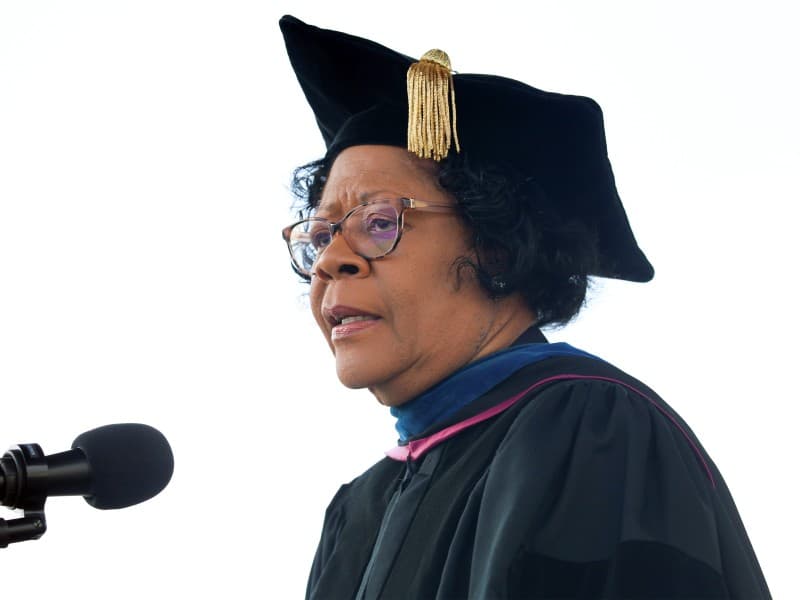
Dr. Jerry Washington Ward Jr. was one of the greatest literary minds of Mississippi and the world who excelled in so many aspects of his work that his talents were often taken for granted and not given their rightful recognition. He was a better poet than most folks’ favorite poet, a better literary theorist than most folks’ favorite literary theorist, a better editor than most folks’ favorite editor, a better educator than most folks’ favorite educator, a better mentor than most folks’ favorite mentor, and he could cut a mean electric slide like nobody’s business.
His poetry continues to teach the power of a concise and precisely vivid image while his essays make plain that the job of the literary critic is not to show how smart or smug one is but to show readers how the creative work reflects the community we have created—its successes, its failures, its flaws, and its possibilities—as a way to inform, heal, and inspire us to be and build better today than we did yesterday.
Moreover, he was the primary bridge from the generation of Richard Wright and Margaret Walker Alexander to my generation of Mississippi writers as he maintained the standard of excellence in all things literary. Co-founder of Callaloo with Charles Rowell and Tom Dent while all three were professors at HBCUs, Doc Ward helped create one of the three top black literary journals on the planet that provides space for black writers as it nurtures, illuminates, and enhances black genius. His two most noted works are Trouble the Water: 250 Years of Black Poetry and Black Southern Voices, anthologies that he edited. Yet, my two favorite poems by Doc Ward are “Don’t Be Fourteen (in Mississippi)” and “Jazz to Jackson to John” because they are the epitome of well-crafted imagery that unflinchingly teach the horror of Mississippi history while celebrating the intellect, courage, and beauty of black people’s ability to overcome hell and build a better world.
Master teacher, literary scholar, and student of Ward, Dr. Howard Rambsy includes “Don’t Be Fourteen (in Mississippi)” in his essential list of “77 Poems about Vulnerable Black Boys and Black Men” that Rambsy published as a tribute on Ward’s birthday. Furthermore, when I was publishing and editing Black Magnolias Literary Journal, I used Doc Ward’s poem, “Winter Solitude,” as an example of the type of poetry we desired to publish.
And, to get a thorough understanding of Doc Ward’s literary genius, I recommend purchasing a copy of Conversations with Jerry W. Ward, Jr., edited by Dr. John Zheng.
Still, for all of these accolades, I don’t think there was a better mentor or friend than Doc Ward. Not only do I pale in comparison to him as a teacher, but I was constantly amazed at his ability to mentor so many different types of writers in such a specific and effective way. His mentees never got cookie-cutter advice from Doc Ward, and he never told us what we wanted to hear but what we needed to hear.
I have so many wonderful memories of Doc, but I’ll just share two. First, I gave Doc an eighteen-line poem, and he drew red slashes across all but two of the lines with notes for why they were terrible. Then, he said, “These two aren’t crap. Start there.” Most people hear that story and only focus on him saying the crap part. But few, if any, rarely ask about the notes to the lines that had red marks. Those notes were some of the most intricate and thorough insights explaining why those lines didn’t work. While Doc was no-nonsense, he was always nurturing in his guidance. Most importantly, he never tried to turn his mentees into clones of him but helped us become the best us that we could be.
Next, in 2001, I was nominated for the Tom Dent Award, and I was a finalist with friend and master poet Saddi Khali. I was notified that Brother Saddi won the award and was asked to deliver the keynote, analyzing his work. I was taken aback because I had never heard of the loser of anything being asked to give a public presentation as to why the other person won. As y’all can imagine, I was a bit miffed and told them that I’d get back to them. Of course, whenever someone says, “Let me get back to you,” they don’t plan on getting back to you. A couple of days later, I was with Doc Ward and told him what had happened. Doc sat calmly as I explained how odd that seemed to me. Then, after allowing me to “express myself,” Doc asked, “C Liegh, is Saddi a well-crafted poet?” I replied, “Of course he is, Doc.” He continued, “Do you think he’s worthy of the award?” “Yes,” I replied, and before I could continue, Doc added, “C Liegh, do it. Go give the presentation for your friend who is also a well-crafted poet.” After a pause and sensing my lingering hesitation, he ended with, “C Liegh, literary careers are like God; they work in strange and mysterious ways.” With that, I relented and agreed to give the keynote.
Now, here’s the kicker. At that time, the Tom Dent Award wasn’t a monetary award. However, after I gave my presentation/analysis of Brother Saddi’s poetry, I was offered four paying gigs on the spot to lecture on black poetry, and my presentation on Brother Saddi’s poetry was later published. Once again, Doc Ward had given me some of the best advice of my life, and I’m still grateful for it.
It was my honor to present Doc Ward with the inaugural Reginald Martin Award for Excellence in Criticism as part of the 32nd Annual PEN Oakland-Josephine Miles Literary Awards held virtually in 2021. My remarks included the following: No one is more deserving of this inaugural award than Dr. Jerry W. Ward Jr. He was born in Washington, D. C. in 1943, and his family moved to Mississippi when he was six. He attended Tougaloo College and received a Bachelor of Science degree in 1964. Dr. Ward began his career as a creative writer and theorist, crafting poems and essays that provide both an aesthetic and sociological understanding of the brilliance, beauty, and power of African peoples. His first national publications were in the summer 1972 issue of Black Creation, the 1973 issue of Hoo-Doo, and a 1983 issue of Black Collegian. The publications in Hoo-Doo and Black Collegian led to Ward’s lasting friendships with the late poet and editor Ahmos Zu-Bolton and with poet, fiction writer, playwright, editor, and activist Kalamu ya Salaam. Together with playwright, editor, and activist Tom Dent, these writers helped to shape the core of the post-Richard Wright and Margaret Walker Alexander generations of Afro-Southern literature.
By the early 1970s, Ward became associated with BLKARTSOUTH, an outgrowth of the Free Southern Theater in New Orleans, which was founded in 1964 to nurture and celebrate black theater and to use theater as a tool for social and political reform/activism. As such, Ward regularly published work in its journal Nkombo.
In November 1973, Ward became involved with the work of the Southern Black Cultural Alliance, a community theater coalition, and hosted several of the group’s annual meetings at Tougaloo College. After earning his Ph.D. in English in 1978 at the University of Virginia, Ward served on the SBCA executive committee from 1978 to 1983. He was also an early member of the Mississippi Cultural Arts Coalition (founded in 1982) by poet and activist Barbara “Nayo” Watkins, which published a newsletter Monitor. MCAC was directly responsible for developing the Farish Street Festival in the historic Jackson, Mississippi, district, which became the biggest festival to feature black art in the history of Mississippi.
Ward also worked with noted jazz bassist John Reese’s Black Arts Music Society, which played a major role in the creation of the Jackson Black Music Awards. In 1982, Ward became a founding member of the Jackson Writers Workshop, which published the chapbook Mississippi Earthworks while they supported black theatre at Jackson State University and Tougaloo College. The Jackson Writers Workshop was also responsible for the careers of a new generation of artists, including poet David Brian Williams, poet and playwright Charlie Braxton, who is also one of the most noted hip-hop scholars on the planet, and Grammy Award-winning jazz artist Cassandra Wilson.
The nineties proved to be a watershed decade for Ward as he edited some of the most celebrated and respected anthologies of their time. In 1990 he published Redefining American Literary History, which cemented Ward’s reputation as a first-rate literary critic, archivist, and educator. In 1992 he published Black Southern Voices, which works to widen the notions of black Southern writing. Filled with the traditional names of Richard Wright and Margaret Walker Alexander, the collection works to add further evidence of the merits of black southern writers. However, by including writers such as Angela Davis, the collection also forces readers to reexamine what is considered black Southern writing. In 1993, Ward wrote the “Introduction” to Richard Wright’s Black Boy. And, in 1997, Ward released the seminal Trouble the Water: 250 Years of African American Poetry, which continues to be lauded as an essential text in the study of African-American literature.
Furthermore, he served as a program officer at the National Endowment for theHumanities and co-founded the Richard Wright Circle and the Richard Wright Newsletter with Margaret Walker Alexander, Samuel Allen, Ralph Ellison, Michel Fabre, Dr. Maryemma Graham, and Julia Wright. Yet, in August 2006, Ward completed what many consider his magnum opus, The Katrina Papers. Building on the tradition and structure of Jean Toomer’s Cane, The Katrina Papers is an amalgamation of poetry, narrative, and critical essay woven by the jazz sensibilities of what it means to be a black person constantly taking the pieces and fragments of an arrested or interrupted life and creating a beauty that testifies to the spirit of human survival. Excerpts of The Katrina Papers have appeared in African American Review, Drumvoices Revue, Chicken Bones: A Journal, and Ishmael Reed’s journal, Konch.
For more than fifty-five years, Dr. Jerry W. Ward Jr. has been the epitome of black brilliance, especially in showing that the purpose of the scholar is to lead, guide, assist, and protect those who have been less fortunate than oneself, while creating work that reveals to readers a horizon of greatness that they are able to achieve. Moreover, as a distinguished professor of Tougaloo College, Dillard University, and Central China Normal University (Wuhan), Ward has produced a new generation of teachers, creative writers, and theorists whose work continues to shape and reshape the fabric of African-American literature.