Remembering Medgar Evers on the date of his funeral
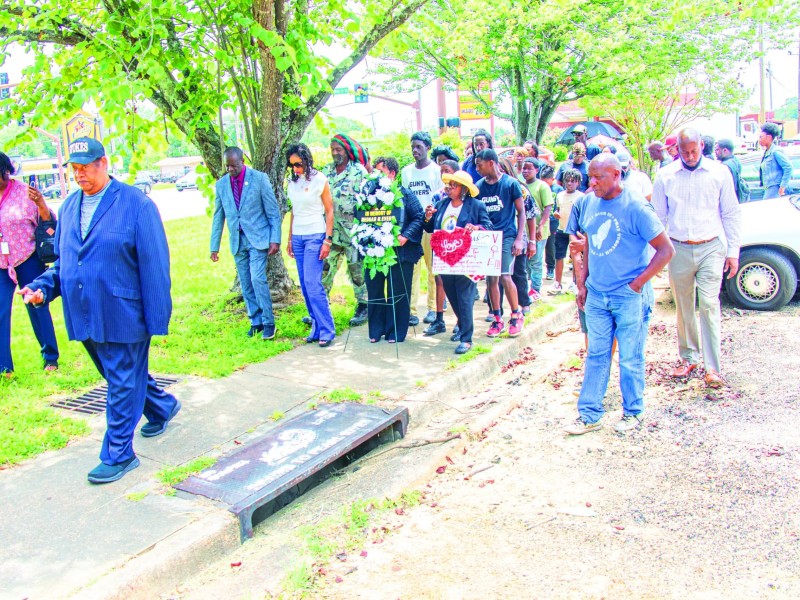
We are very pleased with the role that Charles Evers played in beginning the annual commemoration of the life and contributions of Medgar Evers. We are likewise proud of the labors of Councilman Kenneth Stokes in keeping the tradition alive each spring in the week of Medgar Evers’ assassination.
Medgar Evers was a man for whom praise cannot he overdone. This week, we again add our voice in that praise by remembering Medgar Evers on the date of his funeral, June 19th.
As an impressionable pre-college youngster, the writer of Rosedale, along with his roommates, Fred McDowell of Greenwood and Charles Ralph Morris of New Hebron, first met Medgar Evers in the M.L.S. Drug Store on Lynch Street. This was across the street from the residence of Jacob L. Reddix, who was serving as president of Jackson State College.
The three of us came to Jackson State aware of the developing civil rights movement, but had not been in a position to be activists. There were no organized civil rights activities in Rosedale, Greenwood, or New Hebron at that time. We all had been “sheltered” in segregated schools and towns.
We were, nevertheless, anxious to meet Evers because we were concerned about “equal rights” and were curious about the idea of integration – schools, transportation, public accommodations, and otherwise. During the course of our conversation, Evers not only impressed upon us the importance of the movement and the need for student involvement, but also the work that had to be done.
Following that meeting, we frequently attended mass meetings two blocks away in the Masonic Lodge, where we met and heard Curt Flood as he launched his legal assault on the ownership of major league professional baseball players; Roy Wilkins and Martin Luther King, who championed the virtues of non-violent protests; and Constance Baker Motley, who was a noted civil rights attorney.
We continued to be impressed by Evers’ gentle personality that shone through his keen intellect and determined drive. Consequently, we became participants in the movement through marches and rallies at Campbell College, Tougaloo College, and the two protests that took place at Jackson State College, before the administrative crack-down.
The writer now fast-forwards to the two weeks after his graduation from Jackson State College. While watching television news, he heard that Medgar Evers had been assassinated. Although he had no money and no job, he determined that he was going to attend Evers’ funeral because of what Evers had meant to him and the state. After being able to “borrow” $20 from his family, he bought a round-trip ticket to Jackson, arriving a few hours before the funeral.
By the time he and his schoolmate, Albert Newsome, arrived at the Masonic Lodge, the line of people was so long and the crowd so thick that we realized there was no way for us to even get up to the front door. Following Newsome’s suggestion, we went to the back of the building, climbed up to a second story opening that was apparently used by carpenters, electrical workers, or others when there was a need for repairs or maintenance. From that opening, we crawled until directly above the stage, but out of the sight of the audience and the participants.
Being barely twenty years old, we were not only impressionable, but in this case, daring. We witnessed the entire funeral, including seeing and hearing Dr. T.R.M. Howard, Dr. Martin Luther King Jr., National NAACP Director Roy Wilkins, Dr. Aaron Henry, and Dr. Gilbert Mason. This experience helped us realize the true loss in Medgar Evers’ assassination. It also caused us, like many others, to realize there had to be a new day in Mississippi. It was a sad day, but it was also one that helped us chart our careers of public service that was wrapped in the quest for full-fledged civil rights and democracy.
The writer takes this opportunity to praise Evers once more for what he meant to me as an impressionable adolescent and for the memories that never grow old.
Author