‘Back in the Day’ program helps keep community focused on present, future
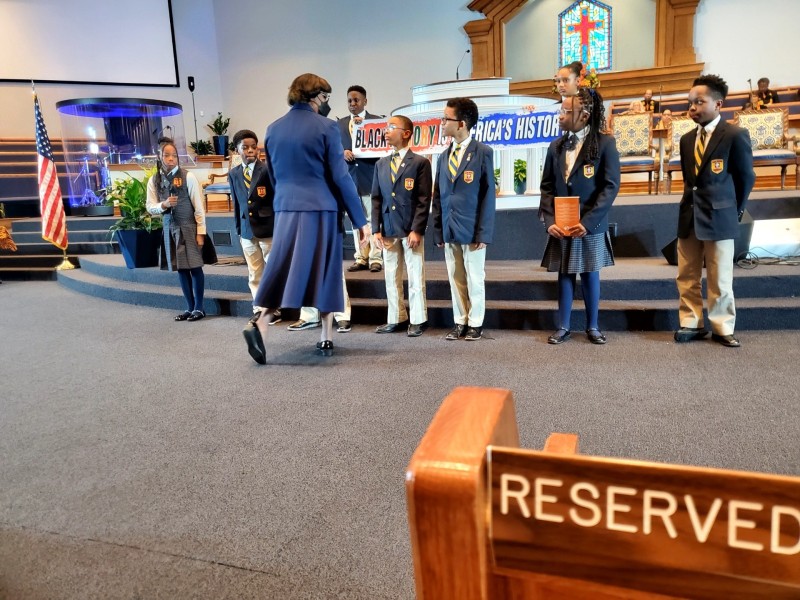
On Thursday evening, February 8, 2024, we witnessed New Hope Baptist Church’s 13th Annual “Back in the Day” Black History Celebration. It was an occasion that honored three civil rights legends, hence the phrase, “Back in the Day.” The program, however, turned into much more, with the fifth-grader class from New Hope Christian School and MADDRAMA of Jackson State University raising the roof and arousing the audience.
Chairwoman Flonzie Brown Wright’s committee had contacted Mr. Bennie Richard, Mayor Robert Walker, and the family of Mrs. Maude Lerita Williams Ballou and arranged for them to be honored. Mrs. Ballou was posthumously honored for her faithful service as secretary to Dr. Martin Luther King Jr. She was represented by her son, WLBT-TV3 anchorman Howard Ballou, who related what her work and life were like working with King during those days. Mr. Richard related how he and his family had donated land to build what became the Richard School for Black underprivileged children in Rankin County. The Black community then experienced the burning of the school, which was re-built as one of the Rosenwald Schools. Mayor Walker, rather than spending a great deal of time talking about his becoming the first Black mayor of Vicksburg, talked mostly about the political, educational, and other needs of today and about how each generation must realize that it has to stand on the shoulders of those who have gone before.
The talks and awards presentations to those legends were preceded by New Hope Christian School and then by MADDRAMA. The younger students who performed included Roxi Mabry, Kaleb Parker, Ayden White, Zaylee Burns, Cali Catchings, Michael Washington, Channix Coleman, Zaire Smith, and Braylon Sample.
Under the caption, “What Black History Means to Me,” they spoke on Black persons who inspire them. Among those persons were such past heroes and heroines as Benjamin Banneker, Thurgood Marshall, the Tuskegee Airmen, Granville T. Woods, Richard Allen, Martin Luther King Jr., and Madame C. J. Walker. As each was named, the scholar explained what they had done to inspire them.
Also included on their list were contemporaries and members of New Hope, such as Mr. William McElroy, Representative Justis Gibbs, Dr. Myrna Alexander, Judge Patricia Wise, Dr. Jerry Young, and Dr. Flonzie Brown Wright. The class summed it up by letting the audience know that the inspiration provided by those heroes and heroines is what Black History means to them. In order to maximize their effect, their teachers, Mrs. Yvonne Jones and Mrs. Esther Sutton, arranged them as a spoken word choir, which the audience truly appreciated.
The JSU award-winning dramatic troupe MADDRAMA followed the New Hope students with a tribute to Black legendary figures as well. The students indicated that when they look in the mirror they see reflections of the likes of Bob Moses, who came to Mississippi to help lead the Freedom Summer and Mississippi Freedom Democratic Party campaigns and stayed on to direct the Algebra Project; Mrs. Amelia Robinson, who was an active leader in the Selma to Montgomery March; Ambassador Ralph Bunche, who was given the Nobel Peace Prize for his diplomatic efforts in Israel; and Mrs. C. Delores Tucker, who was an outspoken leader in the civil rights and women’s rights struggles. MADDRAMA is composed of students from Jackson and Mound Bayou, in Mississippi as well as students from Illinois, Georgia, Louisiana, Michigan, and California. They are directed by the founder, Dr. Mark Henderson.
In this article, the focus is on the fifth-graders of New Hope and on MADDRAMA, not to minimize the rest of the program, but to emphasize the primary aim of Black History celebrations. The rest of the program was a premiere presentation, including the New Hope Choir, the comments from the moderators, chairwoman, and the pastor.
The aim of this and other such programs, however, is to more clearly show the oppression through which Black people have been and the resistance which they have subsequently had to display; the achievements and contributions which they have made because of their intelligence and persistence; and the struggle which is still ahead, despite what was inherited from Africa and despite what the various heroes and heroines, both sung and unsung, have done. Both the New Hope students and the JSU students seem to have gotten the point.
To the extent that these students understand and nurture that knowledge and understanding, the time spent on these Black History programs will truly have been well spent. Therefore, it is hats-off to the teachers, directors, and program planners. It is full speed ahead to these and future generations of students. You have the blessings and backing of those of us who are from “back in the day.”
Author